When most companies hear FSMA 204, the conversation turns to compliance: what data to capture, which foods are covered, what records to keep. Those questions matter, but they aren’t the bigger issue.
At its core, FSMA 204 is about trust. When something goes wrong, companies need to answer a simple question quickly: where did this product come from, and where did it go? Two recent outbreaks show why that answer matters.
A Jalapeño Doesn’t Stay a Jalapeño
In August 2026, the FDA and CDC investigated a multistate Salmonella outbreak linked to fresh jalapeño peppers from Sinaloa, Mexico, distributed by Coast Citrus Distributors. By the time the investigation was updated, more than 400 people had been sickened across dozens of states — and the story didn’t end with fresh jalapeños. Recalls spread downstream to pico de gallo, guacamole, salsa, dips, stuffed mushrooms, soup mix, and other finished products.
A jalapeño starts its journey with an identity: a grower, a lot, a GTIN, and a pallet SSCC. From there it may pass through a packing house, one or more distribution centers, and a processor before reaching a customer. Along the way the path rarely stays neat. Cases are split, pallets are rebuilt, and ingredients are combined into new products. The physical product keeps moving and changing; the question is whether its identity moves with it.
Inventory Isn’t the Same as Lineage
Most distribution centers already know what arrived and who sent it, whether through a WMS, an ERP, or a TMS. That information is useful, but it doesn’t answer the questions a food safety event actually raises: Which lot was on that pallet? Were cases split onto another pallet or sent to another facility? Were they used as an ingredient? Which customers received them?
Inventory tells you what you have. Lineage tells you where it came from, what happened to it, and where it went. That distinction matters most when the information you receive during an investigation is incomplete.
One Notification, Two Ways to Respond
Imagine a recall notice narrowed to a GTIN, an unknown lot, Mexico as country of origin, and a four-month date range. You don’t have the exact lot yet, but you have enough to start investigating who received it, where it is now, and what it became.
Without preserved lineage, someone has to search the WMS, pull purchase orders, and comb through receiving records to find every matching receipt. Then comes the harder work: determining, case by case, what happened to that product afterward — whether it was repacked, transformed, moved, or shipped. The answers may exist, but they’re scattered across systems, spreadsheets, and people. Depending on the complexity of the supply chain, reconstructing that history can take days or weeks.
With preserved lineage, the same starting facts lead straight to the matching receipts and lots. From there, each lot can be followed forward:
Receipt → Source Pallet → Transformation / Repacking → New Pallet or Finished Product → Shipment → Downstream Customer
If cases moved to a new pallet, became an ingredient, or shipped to multiple customers, those relationships were preserved as they happened. Instead of reconstructing the past, the organization follows a trail that already exists and can say, within minutes, which lots it received, what happened to them, and who received the result. That difference isn’t just efficiency — it’s confidence, and confidence is what creates trust.
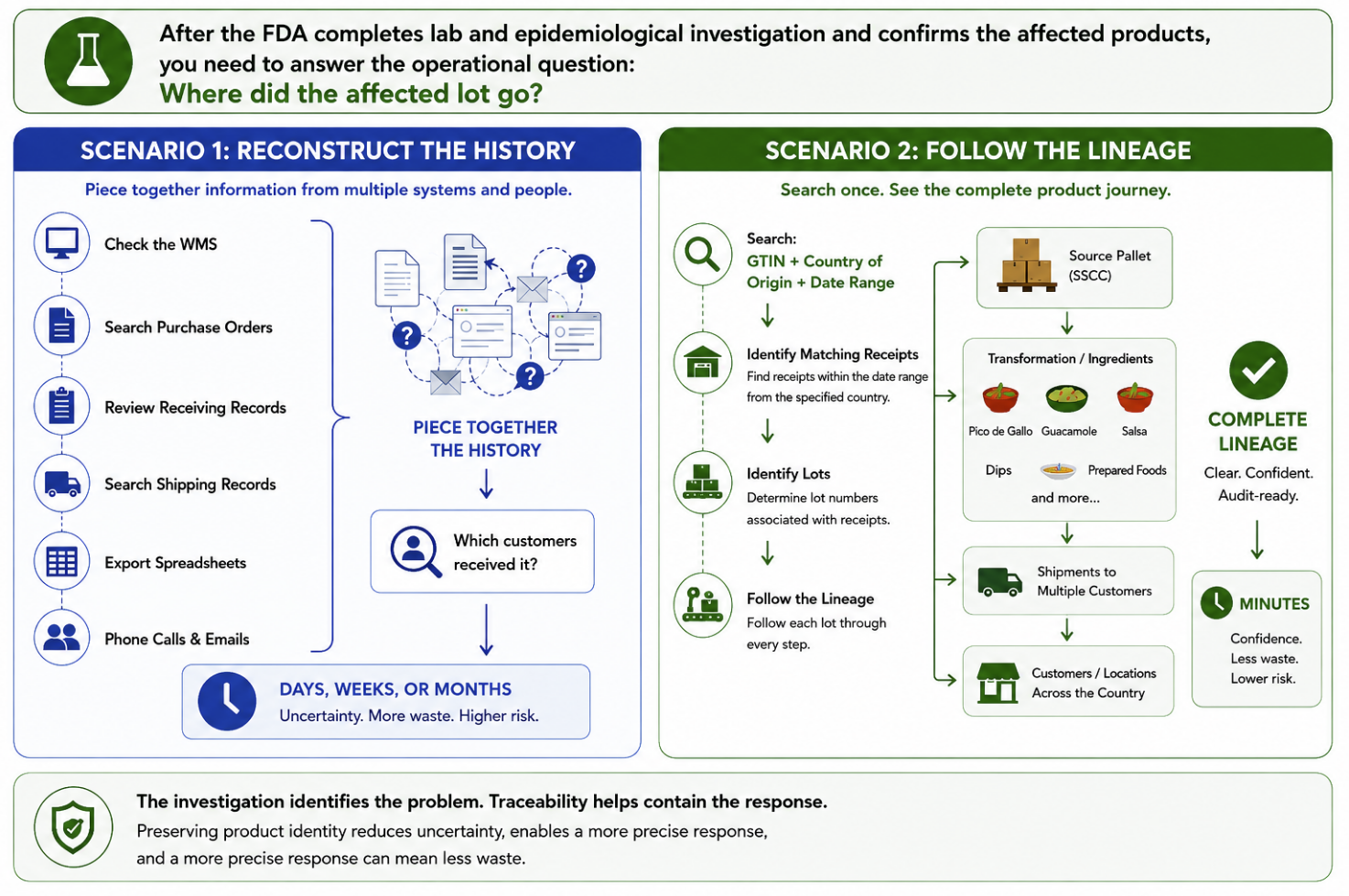
Figure: The same recall notice, two responses. Reconstructing history from scattered systems can take days or weeks; following preserved lineage answers the same question in minutes.
Traceability Has to Survive Transformation
Food doesn’t always stay in the form it entered the supply chain in. A case of jalapeños can become an ingredient in pico de gallo or guacamole, and although the finished product has a new identity, its relationship to the original ingredient still matters. Traceability can’t stop when the original pallet is broken apart; it has to preserve the chain:
Original Product → Lot → Source Pallet → Quantity Used → Transformation → Finished Product → Shipment → Customer
That points to a simple operating principle: preserve lineage when the physical event happens. Capture it at receipt, when a pallet is broken down, when a new one is built, when an ingredient goes into a finished product, and when product ships. The alternative is trying to recreate those relationships after something has already gone wrong. Traceability shouldn’t begin with the recall; the recall should reveal the value of the traceability that was already there.
Precision Matters Because Uncertainty Has a Cost
Trust isn’t only about knowing what is affected; it’s also about knowing what is not. In the July 2026 Cyclospora outbreak linked to iceberg lettuce, FDA’s traceback pointed to lettuce from central Mexico, and Taylor Farms de Mexico voluntarily pulled all iceberg lettuce sourced from that region — going well beyond the specific lots FDA had identified, out of caution.
Uncertainty expands the response. When an organization can’t confidently isolate affected product, the safer move is to cast a wider net: more inventory on hold, more product pulled, more customers contacted, more food discarded that was never actually affected.
Picture a distribution center with 20 pallets of lettuce, where only two carry an affected lot. With preserved identity, the organization can isolate those two pallets and trace exactly where they went. Just as importantly, it can show that the other 18 pallets were never associated with that lot at all. That is the other side of traceability: not just “show me everything that might be affected,” but “show me exactly what is affected, and what is not.”
That precision has real operational value — less unaffected inventory on hold, fewer customers unnecessarily impacted, less labor spent reconstructing records, and less food discarded for no reason. The logic is straightforward:
Preserve identity → reduce uncertainty → respond more precisely → reduce unnecessary waste
That’s a business case for traceability that exists well beyond regulatory compliance.
Trust Extends Beyond the FDA
Regulators are only one stakeholder in this chain. A distributor needs to trust what a supplier tells it, a retailer needs to trust its distributor, a supplier needs to show where its product went, and consumers need confidence that the supply chain can respond quickly and accurately when something goes wrong.
When a downstream customer asks, “Did the product you shipped us contain an affected lot?” there are two powerful answers: “Yes, here’s exactly which shipment,” or “No, here’s proof it wasn’t associated with the affected lots.” Both require confidence in the underlying product identity. Traceability is infrastructure for trust, not just a regulatory burden.
FSMA 204 Creates an Opportunity
FSMA 204 creates regulatory urgency, but the real opportunity is building an operational capability that preserves product identity as food moves through the operation — one that can answer not only what happened to this product, but what can confidently be ruled out. When the next food safety event happens, the question won’t be how good your compliance program looks on paper. It will be: where did the product come from, and where did it go? The speed and confidence of that answer are what build trust.
Where TracAssure Fits
TracAssure™ is a traceability execution platform — a product of 3Roots LLC — built to preserve product identity at the point of work rather than reconstruct it after a recall. It captures traceability as the physical events happen: at receiving, when pallets are broken down and rebuilt, when ingredients go into finished products, and when product ships.
Its Traceability Resolution Engine is designed for real-world conditions — partial scans, mixed pallets, missing labels, and incomplete upstream data — so lineage stays intact even when the inputs aren’t perfect. The result is trace-back and trace-forward in seconds, and a records request you can answer with confidence instead of a scramble.
See where your traceability gaps are → — or email contact@tracassure.com for a 30-minute walkthrough.
Sources
- U.S. Food & Drug Administration — Outbreak Investigation of Salmonella: Jalapeño (August 2026)
- U.S. Food & Drug Administration — 2026 Recalls of Food Products Associated with Fresh Jalapeños from Sinaloa, Mexico, Distributed by Coast Citrus Distributors
- U.S. Food & Drug Administration — Investigation of Multistate Outbreak of Cyclospora Illnesses: Iceberg Lettuce (July 2026)
- U.S. Centers for Disease Control and Prevention — Cyclospora Outbreak Linked to Iceberg Lettuce (2026)
This article is provided for informational purposes only and does not constitute legal advice. Consult qualified counsel for guidance specific to your regulatory obligations.